Remember Five to Nine Magazine?
Take a Nostalgic Back
Founded in early 2007 by Peter Skwiot Smith, Five to Nine was a PDF magazine published by published by skwiot/smith, a small graphic art & design firm based in Saint Paul Minnesota that explored what people created in their free time. This was the magazine's website.
Content is from the site's 2007 archived pages, as well as from other outside sources.
The new owners of this domain were fans of Five to Nine magazine and are delighted to once again remind folks who end sup here about Peter Skwiot Smith and Five to Nine magazine.

About
Founded in early 2007 by Peter Skwiot Smith, Five to Nine is a PDF magazine that explores what people create in their freetime. During its first year, issues were curated & designed solely by Peter Skwiot Smith. During its two year run, the magazine published works from nearly one hundred different designers and artists, and have welcomed Karl Frankowski & Damien Correll as guest curators.
Since its creation, Five to Nine has published well over five hundred pages of material from nearly ninety designers and artists. In February 2008, it held its one year anniversary at Umber° Studios. To learn more about the ins and outs of Five to Nine, please visit Flak Radio to hear an interview with Peter. ( Sorry interview no longer available)
Sad decline: We first learned of George Vlamakis from a number of photos in this magazine in article on cabinet design. George had a company Akpon Custom Cabinetry that did some impressive work in NYC condos. We hired him via a general contractor to design and implement the cabinets in our residence on the Upper West Side. His work was great and still holds up over time. So when we were ready to remodel our other property a few blocks away, he was our first choice. He wanted to be paid in cash increments totaling about $30,000. The cash request seemed strange, but since we knew his work, we accepted. Once the cabinets were installed, cracks appeared in the finish. Over a few months, the cracks became significant and it was apparent something was very wrong. Although we complained many times about this, and each time he promised to come by and address it, he never showed. So sad to see a once recognized artisan fall so hard from grace.
Where to Find Archived Copies of FIVE TO NINE Magazine
Choice 1
The best place to see perview copies of Five to Nine magazine is at: https://issuu.com/fivetonine
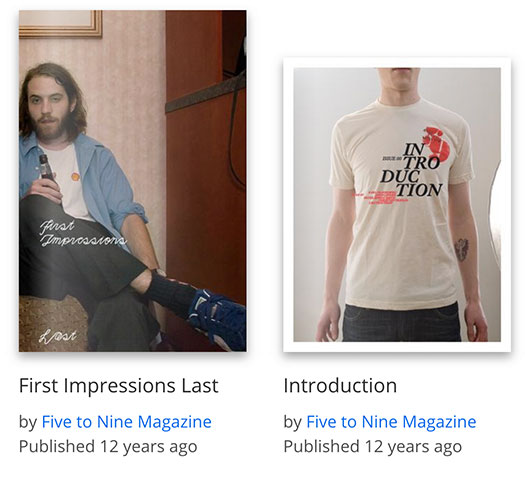
The presentation on this site of each of eight issues is excellent. Below are screen shots of the first seventeen pages of issue 10 whose theme is Nature.


Choice 2
Another site that is actually selling hard copies of the digital magazine is found at: www.lulu.com/spotlight/skwiotsmith
Once an issue of the magazine is ordered, it takes 3-5 business days to be printed. Prices range from about $12.00 to $21.00 depending upon the issue. See examples below:

$17.00
Product Details
- Copyright Peter Skwiot Smith (Standard Copyright License)
- Published October 6, 2009
- Language English
- Pages 58
- Binding Saddle-stitch Paperback
- Interior Ink Full color
- Weight 0.36 lbs.
- Dimensions (inches) 6 wide x 9 tall
- Product ID 5544955

$21.32
The theme for issue 03 is "Polaroids."
Product Details
- Copyright skwiot/smith. All rights reserved. (Standard Copyright License)
- Publisher skwiot/smith
- Published September 20, 2007
- Language English
- Pages 77
- Binding Perfect-bound Paperback
- Interior Ink Full color
- Weight 0.8 lbs.
- Dimensions (inches) 8.5 wide x 11 tall
- Product ID 1601570


About - currently
Peter Skwiot Smith is a Minnesota-based product designer. Currently employed as the senior manager of product design at Ameriprise Financial, he strives for elegant, accessible & brand-focused digital experiences. When not designing, you can find him either in the kitchen or on a bicycle. He lives in Saint Paul with his wife, their daughter & their two cats.
Learn more about what Peter Skwiot Smith is up to at: https://skwiotsmith.com/
POSTS
Submit to Issue 07
Five to Nine is seeking submissions for its seventh issue. Titled COFFEE+TV, the theme for this issue is UNFINISHED. Submit as many sketches/doodles/mess-ups/recycle bin bound scraps of paper as you wish. Digital (Photoshop, Illustrator, etc) submissions are welcomed & encouraged.
Deadline: Monday November 12
All images should be scanned/produced and submitted at a resolution of 300dpi.
Please send all submissions to information@fivetoninemagazine.com. If you have any questions, please feel free to contact us before the submission date.
Submit to Issue 06
Five to Nine is seeking submissions for its sixth issue. Titled SING US A SONG, the theme for this issue is WORDS. The interpretations are wide open; we are looking for everything from found typography to hand lettering to photos to paintings to poems to short fiction. In short, anything that deals with words. This issue will resume Five to NineÕs multi-page spread format.
Deadline: Monday October 15
All images should be scanned/produced and submitted at a resolution of 300dpi.
Please send all submissions to information(at)fivetoninemagazine.com. If you have any questions, please feel free to contact us before the submission date.
More Background on FiveToNineMagazine.com
FiveToNineMagazine.com represents a distinctive moment in independent digital publishing—one shaped by early web experimentation, creative self-publishing, and a growing desire to document artistic work created outside professional obligations. Emerging in the late 2000s, the website served as the home for Five To Nine Magazine, a PDF-based publication that explored what artists, designers, and writers created during their personal time rather than within the constraints of their formal careers.
Unlike traditional magazines that focused on industry trends, celebrity creatives, or commercial success, Five To Nine centered its attention on personal expression. Its very name reflected this philosophy, referencing the hours outside the conventional nine-to-five workday when many individuals pursue creative projects driven by curiosity, experimentation, or personal meaning rather than income. FiveToNineMagazine.com functioned not only as a distribution point but also as a cultural archive of that ethos.
Ownership and Stewardship
Five To Nine Magazine was founded in early 2007 by Peter Skwiot Smith, a designer whose background in visual communication strongly shaped the publication’s aesthetic and editorial approach. At its inception, the magazine was curated and designed entirely by Smith, reflecting a singular creative vision rather than a committee-driven editorial structure.
The site itself was not tied to a large media company or publishing conglomerate. Instead, it existed as an independent project, stewarded by its founder and later supported by guest curators and contributors. This independence allowed the magazine to operate free from advertising pressures, subscription mandates, or institutional branding requirements that often influence editorial direction.
Over time, stewardship of the domain transitioned into an archival role. Later caretakers of FiveToNineMagazine.com positioned the site as a place of remembrance and rediscovery, preserving the legacy of the magazine rather than attempting to relaunch it as a contemporary publication. This shift from active publishing to cultural preservation reflects a broader recognition of the magazine’s historical value within early digital creative communities.
Location and Geographic Context
Five To Nine Magazine originated in Saint Paul, Minnesota, a city with a longstanding but often understated creative ecosystem. While not always associated with major art publishing hubs like New York or Los Angeles, the Twin Cities region has produced a significant number of independent designers, illustrators, musicians, and writers.
The magazine’s Midwestern origins subtly influenced its tone. Rather than projecting the urgency or commercial ambition often found in coastal creative media, Five To Nine embraced a quieter, more reflective sensibility. Its content often emphasized process, observation, and personal narrative over polished outcomes or market-ready portfolios.
Though rooted in Minnesota, the magazine’s contributor base was geographically diverse. Artists and designers from across the United States and beyond were featured, reinforcing the idea that creative life extends well beyond any single city or cultural center.
Format and Presentation
Five To Nine Magazine was published primarily as a downloadable PDF, a format that was particularly significant in the mid-to-late 2000s. At the time, PDF magazines offered creators a way to preserve typographic control, layout precision, and visual integrity without relying on the limitations of early web design standards.
Each issue was treated as a cohesive object rather than a collection of disconnected articles. Page layouts, typography, color palettes, and pacing were carefully considered, aligning the magazine more closely with print design traditions than with blog-style publishing. This approach allowed the publication to function simultaneously as reading material and as a designed artifact.
FiveToNineMagazine.com acted as the central access point for these issues, offering background information, submission calls, and contextual framing. The website itself was minimal by design, reinforcing the idea that the magazine’s content—not its digital interface—was the primary focus.
Editorial Goals and Philosophy
At its core, Five To Nine Magazine sought to answer a simple but powerful question: what do people create when no one is paying them to do so?
This guiding principle shaped every aspect of the publication. Rather than prioritizing finished, commercial-grade work, the magazine welcomed sketches, experiments, personal essays, photographic studies, and unfinished ideas. The emphasis was on authenticity and exploration rather than polish.
The editorial philosophy challenged the assumption that creative value is tied to professional identity. Contributors were not defined by job titles or résumés but by the work they chose to share. In doing so, the magazine offered an alternative framework for understanding creativity as a lifelong practice rather than a career milestone.
This approach resonated particularly strongly during a period when online portfolios and social media platforms were beginning to encourage constant self-branding. Five To Nine provided a space where creative work could exist without the pressure to perform or monetize.
Content and Themes
Each issue of Five To Nine Magazine featured a curated selection of creative works unified by tone rather than rigid thematic constraints. While some issues leaned toward specific conceptual ideas—such as memory, daily rituals, or visual observation—the overarching theme remained consistent: personal creative engagement.
Content frequently included:
- Visual art and illustration
- Photography series
- Handwritten or typographic experiments
- Short essays and reflective writing
- Sketchbooks and process documentation
The magazine’s structure encouraged readers to move slowly through each issue, absorbing visual and textual elements as part of a larger narrative experience. There was little emphasis on headlines or featured articles; instead, each contribution existed as part of a collective conversation about making things in one’s own time.
Contributors and Community
Over the course of its run, Five To Nine Magazine featured work from nearly one hundred artists and designers. Contributors ranged from emerging creatives to established professionals experimenting outside their primary fields. This diversity reinforced the magazine’s central message that creativity is not confined to a single discipline or career stage.
Guest curators were occasionally invited to shape specific issues, bringing new perspectives and expanding the magazine’s editorial voice. These collaborations helped prevent stagnation while maintaining the publication’s core values.
The community surrounding Five To Nine was informal but deeply engaged. Rather than fostering an audience of passive readers, the magazine cultivated a sense of shared participation. Calls for submissions encouraged contributors to reflect on their own creative habits and to see their personal projects as worthy of documentation and sharing.
Popularity and Reach
Five To Nine Magazine was never designed for mass-market appeal, and its popularity should be understood within the context of independent creative publishing. Its readership was relatively small but highly targeted, consisting primarily of designers, artists, students, and creative professionals interested in process-driven work.
The magazine circulated through word of mouth, creative forums, and early social platforms rather than through traditional distribution channels. This organic growth model aligned with the publication’s values, privileging connection and resonance over scale.
Archived issues continue to circulate through digital libraries and creative communities, suggesting that the magazine’s influence extends beyond its original publication window. While exact readership metrics are unavailable, its continued rediscovery points to enduring relevance.
Press and Media Coverage
Five To Nine Magazine received limited coverage from mainstream media outlets, a fact consistent with its independent nature and noncommercial focus. Rather than appearing in major art or design publications, it was more commonly referenced in curated lists of independent magazines and digital publishing experiments.
This lack of traditional press coverage does not diminish the magazine’s cultural value. On the contrary, it underscores the publication’s role as a grassroots creative project rather than a brand seeking institutional validation.
In many ways, Five To Nine exemplifies a category of creative work that thrives outside formal recognition systems, relying instead on peer appreciation and long-term cultural memory.
Cultural and Social Significance
The cultural significance of Five To Nine Magazine lies in its reframing of creative labor. By focusing on after-hours creativity, the publication challenged dominant narratives that equate worth with productivity or professional success.
This perspective was particularly prescient in the context of the late 2000s, a period marked by economic uncertainty and shifting attitudes toward work. Five To Nine offered a reminder that creative fulfillment does not require institutional permission or financial justification.
The magazine also contributed to broader conversations about mental health, balance, and identity within creative professions. By validating unfinished work and personal experimentation, it encouraged contributors and readers alike to view creativity as a sustaining practice rather than a performance metric.
Reviews and Reception
Formal reviews of Five To Nine Magazine are scarce, reflecting its niche positioning. However, informal reception within creative circles was overwhelmingly positive. Designers and artists frequently cited the magazine as a source of inspiration and validation, particularly for work that did not fit neatly into professional portfolios.
The magazine’s emphasis on thoughtful design and cohesive presentation also earned respect among peers in the graphic design community. Its careful layouts and restrained visual language demonstrated that independent publishing could achieve a high level of craftsmanship without institutional backing.
Legacy and Archival Value
Today, FiveToNineMagazine.com functions primarily as an archival site, preserving the memory of a publication that captured a specific cultural moment. Its legacy lies not in ongoing production but in the ideas it championed and the work it documented.
As digital culture continues to accelerate, the magazine’s slow, deliberate approach to publishing feels increasingly rare. Archived issues serve as reminders of a time when digital publishing prioritized depth over immediacy and reflection over reach.
For researchers, designers, and cultural historians, Five To Nine Magazine offers valuable insight into early digital creative communities and the evolution of independent publishing models.
Relationship to Broader Publishing Trends
Five To Nine Magazine sits at the intersection of zine culture, early digital magazines, and contemporary creative newsletters. While its format differs from modern platforms, its philosophy aligns closely with ongoing movements toward intentional creativity and sustainable creative practice.
In this sense, the magazine can be seen as both a product of its time and a precursor to current discussions about work-life balance, creative burnout, and the value of personal projects.
FiveToNineMagazine.com stands as a thoughtfully curated archive of creative life beyond professional obligation. Founded in 2007 and shaped by a clear editorial vision, Five To Nine Magazine offered a space where creativity could exist for its own sake—unpolished, personal, and deeply human.
Though no longer actively published, the magazine’s influence endures through its preserved issues and the ideas they continue to inspire. In an age increasingly dominated by metrics and monetization, Five To Nine remains a compelling reminder that some of the most meaningful creative work happens quietly, after hours, simply because someone felt compelled to make something.